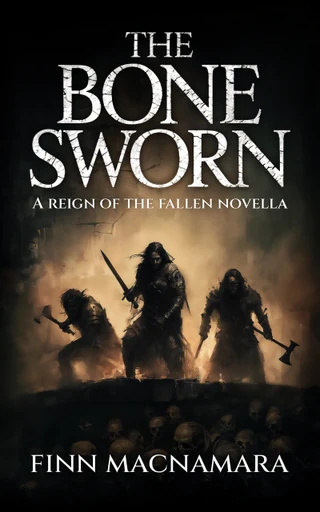
Blood Mist · Finn MacNamara
The Iron Vow · Book 2
Chapter One
The shale gave under Hudd’s boot.
He shifted his weight back, caught himself with his other leg braced against a jut of rock, and forced his breathing to stay even. Below him, the ravine dropped forty feet into a mess of broken stone and skeletal brush. The wind gusted up from the gap, cold enough to sting his eyes.
A fall there wouldn’t kill clean. It would break him, and then the stream would finish the work.
He didn’t look down again. Looking down was how you invited the land to take you. He forced his heel down and shifted his weight to the uphill foot. The loose sheet of shale shivered and settled.
Behind him, Nukdarog stood with both feet planted like she’d grown from the rock. The ogre’s bulk made the ridge feel narrower. Her shadow fell across him when the cloud thinned, a dark block against the grey stone. She watched the ravine as if it offended her by existing.
“Not straight,” Hudd said. “We angle across. That strip there—the roots hold it.”
Nukdarog looked where he nodded: a seam of scrub and stunted pine clinging to the slope like a scab. She didn’t answer. She rarely did, although she had started to talk more. Maybe two words a day now instead of one.
He started again, placing each boot on the few places that looked like they might keep their shape. The slope forced him to choose. Faster meant less time in the open. Slower meant safer, but the longer they hugged bare rock, the more likely someone on the ridge line might see them.
If anyone were watching.
He hated the way the thought kept coming back. Country like this made you think in circles. The hills rolled out in folds of grass and stone, and the forests crouched in pockets where the ground broke and water ran, and there were too many places for eyes to live.
A gust hit the ridge and shoved at his cloak. The fabric snapped against his calves like an impatient hand.
He saw Nukdarog’s tusked profile in the corner of his eye, calm as a slab of meat on a block. The wind tugged at the leather cord around her throat. The twisted iron nail there knocked once against her chest with a dull tap.
She touched it without looking down, just a brief press of thick fingers, and then her hand dropped again.
Hudd eased onto the scrub seam. The roots took his weight, but they were old and shallow. The little pines had been gnawed by weather until their needles were thin and angry. He crouched low and moved like he was crawling along the edge of a roof.
The ravine opened beneath him. Cold, clear water cut through stone. He eyed it wearily. Just water doing what water did, not caring who fell into it.
Across the gap, the opposite slope rose in a steep sweep of grass speckled with autumn scrub. Sun broke through the clouds and struck the hillside, turning the yellowed grass to hammered gold.
The beauty didn’t last. The same light showed the scars.
Old logging cuts striped the lower slopes in long, raw swathes. Stumps sat like black teeth in the earth. Ruts from heavy carts had hardened into dry channels that would become rivers when the weather turned. The trees left standing looked lonely and wrong, too spaced, too exposed to wind that would twist them until they cracked.
He’d seen better forests burned for less reason. Still, the emptiness carried a particular kind of threat. No cover, no food worth taking, no place to hide a body if it came to that.
He reached the point where the seam narrowed to a tongue of dirt. The slope on his left dropped away into the ravine. The slope on his right rose to a strip of bare rock that led back to the ridge top.
A stone popped loose behind him. Hudd’s body tightened before his mind finished the sound.
Nukdarog had stepped down onto the seam, too close. Her weight made the roots groan. Pebbles poured away like teeth.
He hissed a breath through his teeth. “Careful.”
She stared at the ravine, not at him. “Wind.”
As if that explained it. As if the wind were the enemy and not every choice they’d made since the Greywood.
“It’s not the wind that kills you,” he said, and edged forward again. “It’s the hurry.”
She made a noise that might’ve been disdain, might’ve been nothing at all. Like she’d decided his words were a thing she could tolerate for now.
They followed the ledge until it widened into a broken shelf and then a narrow goat-track that climbed out of the ravine. The track was hard-packed earth cut into the slope, pocked with hoof prints and the smaller, sharper stamps of wild things.
The climb out took them into wind again. The ridgeline was a long spine of rock and scrub that ran toward the foothills, and from here the land opened up in a way that made a man feel watched by the sky.
Mist pooled in the lower valleys, white and slow-moving, like breath from something sleeping. It lay thick in the cuts and hollows, hiding the bottoms of gullies. In the distance, hawks circled on steady wings, riding the updrafts.
Hudd watched one bank and dive, quick as a thrown knife. It vanished into mist and came up with something small writhing in its talons. The hawk’s cry cut sharp through the wind.
He kept them off the ridge crest. He chose the lee side, where the wind broke against stone and the sound of their steps got eaten. It meant they couldn’t see as far, but it also meant anyone looking from a distance would have to work to find them.
They moved on, the ground rising and falling in shallow waves. The light shifted through cloud gaps, turning the hills from dull green to bright copper in sudden patches, then back again.
Hudd counted the time in his head without meaning to. If they kept this pace, they’d hit the old road before dusk. If the road still existed. If the way it ran in his memory matched the way it ran now.
He glanced at Nukdarog. The ogre’s gait was steady, heavy but not clumsy. She moved with an animal’s economy, placing her feet where the ground would hold, avoiding loose rock without needing to think about it. She looked like she belonged to the hills more than the hills belonged to themselves.
If she slipped into a ravine, though, she’d take half the slope with her. He didn’t know if the rocks would break her. He didn’t want to find out.
After a few hours, he saw a dark line cut across the hills: the old Mandate road. It ran like a scar, a strip of broken stonework and compacted gravel that still held its shape despite weeds and frost. Hudd slowed before they reached it, crouching behind a boulder studded with lichen.
He listened. Nothing but wind and distant bird calls. No hoofbeats. No wagon creak. No voices.
He rose and crossed, keeping his steps light on the broken stones. Nukdarog followed, not even glancing down at the road like it mattered. To her, the world was forward, and the rest was detail.
On the far side, a milestone leaned at an angle, half swallowed by grass. Its face had been carved once with the Mandate’s neat numerals and a stamped crest. Frost and time had worn the lines down until they looked like old wounds.
Hudd ran a thumb over the crest. The stone felt cold despite the sun. “They came this way,” he said, more to himself than to her. “Put up markers and sent patrols. Thought this would stay theirs.”
Nukdarog’s eyes flicked to his hand. Then, to the road ahead. “Where nails go,” she said.
He didn’t answer that.
They followed the road at a slant, not walking on it, but keeping to the scrub just off its edge where their silhouettes broke. The road dipped and rose with the land, vanishing behind hillocks and reappearing in straight stretches where the Mandate engineers had forced their will onto the earth.
A rotten signpost stood at one bend, its crossbeam snapped, its painted arrows faded to a greenish smear. Someone had hacked at it with an axe, not to take it down clean, but to ruin it. The post had splintered and healed into grey rot, the wood swollen and soft.
The road passed a area of stripped timber works—old staging ground for logging carts. The earth there was bare, churned long ago into hard ridges. Iron hooks lay in the grass, half rusted. A length of chain snaked out of the dirt like a dead thing. The air smelled of old sap and wet metal.
Hudd walked the perimeter, eyes scanning. No fresh tracks. No ash from recent fires. The place had been abandoned in a hurry, not in panic—tools left, but arranged, like men had thought they’d come back. Time had proved them wrong.
He found the outline of a collapsed lean-to. Beneath it, a small pile of split wood sat grey and untouched. Even the desperate hadn’t taken it. That meant either no one came through here, or something had convinced them not to linger.
He forced himself not to look too long at the dark gaps between the trees at the edge of the cut. The forest beyond was dense, damp, and quiet in a way that made his ears strain. Moss muffled everything. Even the wind died there.
Sunlight angled into the forest and caught the webbing between branches, turning each strand into a thin silver line. For a heartbeat it looked like the woods were strung with fine wire.
Then the light shifted, and the silver lines became just webs again—traps you didn’t see until you walked into them.
“Let’s keep moving,” he said.
They left the stripped works behind and climbed onto higher ground where the road ran along a wind-blasted ridge. Here, the Mandate’s hand had been more obvious: a shallow ditch cut for drainage, stones stacked into low retaining walls. Frost had pried at the stones and toppled sections. Grass grew in the cracks.
A half-abandoned watch platform stood on a knoll ahead, four posts sunk into stone with a ladder that had lost two rungs. The platform’s roof was gone. Only the skeletal frame remained, and a torn strip of canvas flapped from one beam like loose skin.
Hudd didn’t like leaving such things unlooked-at. The platform would give him a good view of the surrounding country.
He motioned Nukdarog to stay low in the scrub. She didn’t argue, but her stillness had weight to it. He felt like he was testing her patience.
Hudd approached the ladder, testing the first rung with his boot. The wood creaked like an old man’s joints. He climbed anyway, slow and careful, keeping his weight close to the posts. The wind hit harder up top, and the platform swayed just enough to make his stomach tighten.
From the platform, the world spread. Hills rolled away toward the foothills, where the land rose sharper and the tree line thickened into darker forest. Beyond that, the first teeth of mountains cut the horizon, pale and jagged under cloud.
He scanned for movement and saw nothing.
He did see signs of people. A line of abandoned crofts far off—small squares of stone that caught the light. A stretch of road that dipped into a valley and vanished into mist. A patch of forest that looked oddly thin, as if something had moved through it repeatedly and worn it down.
He couldn’t prove anything from this height. He could only feel the shape of the emptiness.
He climbed down and returned to Nukdarog. She watched him as he approached. He hated that about her. He could read a man’s posture, his hunger, his fear. Nukdarog was a wall with a furnace behind it.
“We keep off the road,” he said. “Use the folds. If there’s a patrol, we don’t want to meet it where they can see us coming.”
Her gaze slid past him toward the foothills. “We meet,” she said. “We break.”
“Not yet.” He kept his voice flat, not pleading, not soft. “We need them to lead us. Dead men don’t walk you to their master.”
She stared at him for a long moment, and he felt the old tension in his neck scar tighten. Then she spoke, and the words were heavy as stones.
“Targets,” she said.
“You’ll have them.”
“And nails.”
He held her gaze. “Nails too.”
That was the trade.
They moved again, dropping off the ridge into a shallow bowl where bracken grew thick and wet. The air changed here. It smelled of damp earth and crushed fern. Their boots sank slightly, leaving prints that would hold for days if the weather stayed dry.
Hudd disliked that. He disliked leaving a trail.
He took them along a deer path that skirted the wettest ground. The path wound between low boulders and twisted shrubs. At one point, it passed a small stream, no wider than a man’s stride, running clear over pebbles. Sunlight in the water made it look like spilled coins.
He knelt and drank without taking his eyes off the brush line. The water was cold enough to sting his teeth. It tasted clean. That made him suspicious too. Clean things didn’t last near Mandate work.
Nukdarog drank as well, cupping water in her hand and lifting it to her mouth. The motion was strangely careful for something that could crush a man’s skull like a rotten apple. When she straightened, a thin line of water ran down her chin and caught in old scars.
Hudd looked away. Not out of shame. Out of habit. Staring at her too long felt like admitting she was more than an answer to a problem.
They climbed out of the bowl and onto a slope where the grass grew short and wiry. The wind returned, carrying the smell of distant woodsmoke—faint, intermittent. Could’ve been a farm. Could’ve been a camp. Could’ve been nothing but someone burning wet brush in a ditch.
He didn’t trust it.
They walked until the light began to flatten, the sun slipping behind cloud layers that thickened into a grey lid. The temperature dropped. The wind picked up.
Hudd felt the day’s damp settle into his joints. He’d slept too many nights in wet clothes to pretend it didn’t matter. Cold made you clumsy. Clumsy made you dead.
He began looking for a place to hole up before full dark. Not comfort—there was no such thing—but cover. A stand of trees dense enough to break their silhouettes. A rock overhang. A hollow between boulders where wind couldn’t reach.
As they crested another rise, the land ahead dipped toward lower country. The road ran down with it, a pale line threading between hills. Beyond the next ridge, he could see a broader valley. The grass there looked darker. The tree pockets thicker. Settlement country, perhaps—where the hills eased enough for men to plant and build.
The thought should have been relief. It wasn’t.
Hudd slowed, scanning the slope below. He caught movement at the top of his vision and looked up.
Carrion birds—crows, maybe, and a bigger black-winged thing he couldn’t name at this distance—circled beyond the next ridge. Not high and lazy the way they did over old fields. Low. Tight. As if whatever drew them was fresh and they didn’t want to lose it.
The wind shifted. It brought a faint note on top of damp grass and cold stone.
Rot.
Not the sweet rot of a fallen tree or the slow rot of a bog. This was sharper, like old blood.
Hudd’s mouth went dry. He didn’t look at Nukdarog. He didn’t need to. He felt her attention tighten, a predator’s focus drawn by the same scent.
He backed a step into the lee of a boulder, eyes still on the circling birds. The valley waited, silent and dark, with the road leading straight down into it like an invitation.
“Not tonight,” he said, though he wasn’t sure who he was telling.
Nukdarog’s voice came low behind him, almost satisfied.
“Near.”